Table of contents
Personal alarm systems for employees via smartphone
Personal alarm systems help employees who work alone or face increased risks during their work, such as healthcare professionals, installers, cleaners, and employees working outside regular hours.
MultiBel replaces traditional personal alarm systems that rely on separate hardware with a smart smartphone-based solution. Just as pagers and two-way radios are increasingly being replaced by apps, personal alarm systems on a smartphone are the logical next step.

With MultiBel Protect, you have a cloud-based personal alarm solution for all risk categories. You decide which features are required based on your risk assessment, such as a panic button, man-down detection, or interval check-ins. This turns the smartphone into a powerful tool for improving employee safety.
Personal alarm hardware replaced by the MultiBel App
The smartphone acts as the alarm device, meaning separate panic buttons or man-down devices are often no longer required. The panic button is part of a Kiwa-certified system, and the personal alarm solution can be fully tailored to your risk assessment and working environment.
The following personal alarm features are available:
All settings can be configured individually. For example, you can determine:
- At what interval should the lone worker receive a check-in message?
- At what G-force threshold should fall detection trigger an alarm?
- At what angle should the motion sensor detect a man-down situation?

9 benefits of personal alarm systems with a smartphone
1. Flexibility
The way your employees are protected can be tailored to each individual and situation. Depending on the nature of the work, you can choose the most suitable form of protection.
2. Low investment
Personal alarm systems via smartphone require no additional hardware. Most employees already have a smartphone, meaning investments in panic buttons or man-down devices are often unnecessary. Maintenance and service costs are also reduced.
3. Scalability
The number of employees being protected or able to receive alerts can be adjusted easily. The app forms part of a certified alarm system and integrates personal alarm functionality with a professional emergency notification system. In addition, the MultiBel platform also supports applications such as emergency response team alerting, fire alarm notifications, fault reporting, and crisis communication.
4. Simplicity
Smartphone-based personal alarm systems allow alarms to be raised both manually and automatically. Automatic detection uses smartphone sensors, while the panic button is simple and intuitive to operate.
5. Reliability
Predefined recipients are informed immediately when an alarm is activated. If there is insufficient response, the alert can automatically be escalated to other colleagues, a control room, or a private alarm receiving centre.
6. Fast updates and integration
The MultiBel system is continuously evolving. Software updates can introduce new features without the need for new hardware. The MultiBel safety platform also offers a wide range of practical extension modules and, unlike traditional personal alarm hardware, can be easily adapted to your requirements.
7. Presence registration
Automatic presence registration makes it possible to send alarms only to colleagues nearby. If there is insufficient staffing for a particular qualification, MultiBel automatically notifies you or escalates the alert to an alarm receiving centre.
8. Accurate location tracking indoors and outdoors
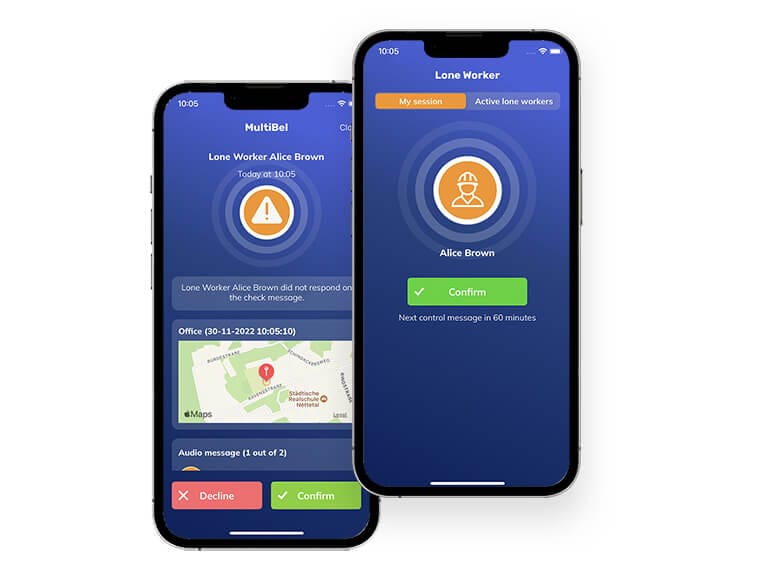
In an emergency, it is not only important that an alarm is sent quickly, but also that responders immediately know where they need to be. Outside buildings, MultiBel uses GPS location data. Inside buildings, MultiBel provides much more accurate positioning through AI-PS (AI-Positioning System). By using existing Wi-Fi networks in combination with artificial intelligence, it can identify where an employee is located, for example on a specific department or floor. This enables first responders, security personnel, healthcare workers, or colleagues to reach the correct location more quickly.
9. Communication
Depending on the situation, a listen-in and/or voice connection can be established with the person requesting assistance. In addition, MultiBel offers chat functionality and the ability to share photos, videos, documents, instructions, and voice messages. This enables faster and more efficient coordination during incidents.
What measures can be taken to improve the safety of at-risk employees?
Organisations can implement various measures to reduce the risks faced by employees who work alone or under hazardous conditions:
- Working within sight of other people
- Frequent check rounds
- Timed calls via telephone or two-way radio
- CCTV monitoring
- Panic button and/or man-down functionality
With MultiBel Protect, traditional monitoring measures can partly be replaced by automatic interval check-ins, a panic button, and man-down detection. This improves safety without requiring additional hardware or time-consuming patrol rounds.
Traditional personal alarm systems or smartphone-based personal alarm systems?
Traditional personal alarm systems often rely on separate hardware, such as panic buttons, man-down devices, or portable transmitters. These tools are used to enable employees who work alone or face increased risks to quickly request assistance.
An increasing number of organisations are choosing smartphone-based personal alarm systems. Employees almost always carry their smartphones with them, making separate devices unnecessary in many cases. This reduces investment and management costs while making the solution easier to administer.
With MultiBel Protect, personal alarm systems, communication, presence registration, and location tracking are combined in a single platform. This enables incidents not only to be reported more quickly, but also managed more effectively.
Which sectors use MultiBel for personal alarm systems?
Typical applications of MultiBel personal alarm systems include:
- Healthcare and mental health services: Community care, consulting room alarms, aggression prevention, and psychiatric wards
- Municipalities and government organisations: Silent alarms for aggression, threats, or inappropriate behaviour
- Industry: Lone workers, hazardous substances, and high-risk installations
- Education: Aggression alarms, active threat alarms, and rapid location tracking during incidents
- Logistics: Employees working in distribution centres and warehouses
- Hospitality: Reception staff, night-shift workers, and security personnel
- Retail: Employees at increased risk of aggression or robbery